OpenAI Reportedly Burned $3.7B in Q1 2026 as IPO Pressure Builds
June 17, 2026 · Peter101CJ
The AI Boom Has a Money Problem
OpenAI is one of the most important companies in the world right now.
It gave us ChatGPT. It pushed AI into the mainstream. It made businesses, schools, developers, writers, investors, and governments take artificial intelligence seriously.
But behind the excitement, there is a simple question people are starting to ask:
Can this business become profitable at the scale everyone expects?
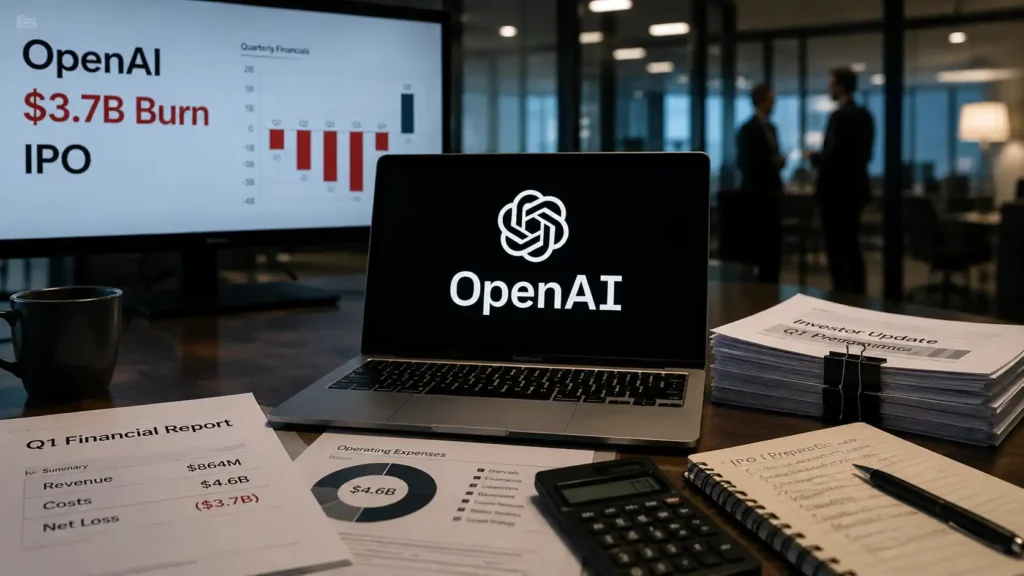
That question became louder after Reuters reported that OpenAI burned through $3.7 billion in the first quarter of 2026, citing documents reported by The Information.
That is not a small number.
And it matters even more because OpenAI is also preparing for a major IPO.
So now the story is not just about how powerful OpenAI’s models are. It is about whether the economics of frontier AI can keep up with the hype.
What Happened?
According to the report, OpenAI spent $3.7 billion in the first quarter of 2026.
That was more than half of its reported $5.7 billion revenue for the same period.
To be clear, this is reported information, not a full public company filing. Reuters also said it could not independently verify the figures.
Still, the numbers are big enough to start a serious conversation.
OpenAI is growing fast. Revenue is rising. Demand for AI tools is real.
But the costs are also huge.
Training models, running ChatGPT, paying for cloud infrastructure, hiring top talent, building enterprise products, and competing with Anthropic, Google, Meta, xAI, and others all require massive spending.
AI may look simple when you type into a chatbot.
Behind the scenes, it is one of the most expensive technology races in history.
Why Is OpenAI Spending So Much?
OpenAI is not spending billions because it is careless.
It is spending billions because frontier AI is expensive.
To stay ahead, the company needs:
- Powerful chips
- Huge data centers
- Research teams
- Safety teams
- Enterprise sales
- Consumer products
- Developer tools
- Model training
- Model serving
- Global infrastructure
Every time millions of people use AI, someone pays for the compute.
That is the strange thing about this business. A normal software product can become cheaper to serve as it scales. AI can scale revenue, but it also keeps scaling cost.
That is why investors are watching the numbers closely.
The question is not whether people want AI.
They do.
The question is whether AI companies can make enough money from that demand after paying the enormous cost of delivering it.
Why This Matters Before the IPO
OpenAI’s planned IPO could be one of the biggest public market events in tech history.
That means the company will have to tell a very clear story to investors.
The story cannot just be, “AI is the future.”
Everyone already knows that.
The stronger story has to be:
“We can turn AI demand into a profitable, durable business.”
That is where the reported cash burn becomes important.
Investors may love growth, but they also want to understand the path to profit. If OpenAI is spending billions every quarter, the market will ask how long that can continue and when the business model starts to look more efficient.
This does not mean OpenAI is weak.
It means OpenAI is entering a different phase.
Private markets reward vision.
Public markets still care about numbers.
Is This an AI Bubble Warning?
Maybe. But let’s not be dramatic.
The AI boom is not fake. People are using these tools every day. Businesses are paying for them. Developers are building with them. Students, creators, researchers, and companies are already changing how they work.
That is real.
But real technology can still become overvalued.
The internet was real in the late 1990s, but many internet companies were still overpriced. The same thing can happen with AI.
The risk is not that AI disappears.
The risk is that investors price every major AI company as if it will dominate the future, while ignoring how expensive the race is.
OpenAI’s reported cash burn is a reminder that the AI revolution has bills to pay.
What This Means for Regular Users
For everyday users, this story may feel far away. But it still affects you.
If AI companies are spending heavily, they may eventually raise prices, limit free access, push more users toward paid plans, or focus more on enterprise customers.
We may also see stronger competition as companies try to win users while lowering costs.
That could mean better products, cheaper models, and faster innovation.
So yes, OpenAI’s spending is a business story.
But it may shape the tools you use every day.
What This Means for Businesses
For businesses, the lesson is simple.
Do not assume AI tools will always be cheap, unlimited, and available in the same way they are today.
AI is becoming infrastructure. And infrastructure has costs.
Companies using AI should think about:
- Which tools are mission critical
- How much AI usage really costs
- Whether they rely too heavily on one provider
- How to protect data
- How to measure real productivity gains
- What happens if pricing changes
AI can save time and money, but only when it is used carefully.
Buying AI because everyone else is doing it is not a strategy.
The Simple Takeaway
OpenAI’s reported $3.7 billion cash burn does not mean the company is failing.
It means the AI race is extremely expensive.
OpenAI is growing fast, but it is also spending heavily to stay ahead. As the company moves toward a possible IPO, investors will want more than excitement. They will want proof that the business can turn massive demand into long-term profit.
That is the real story.
AI may be the future.
But even the future needs a business model.
FAQ
How much did OpenAI reportedly burn in Q1 2026?
OpenAI reportedly burned $3.7 billion in the first quarter of 2026, according to reporting cited by Reuters.
Why is OpenAI spending so much money?
OpenAI spends heavily on computing power, model training, infrastructure, research, staff, enterprise products, and global AI services.
Is OpenAI preparing for an IPO?
Yes. Reuters has reported that OpenAI confidentially filed for a U.S. IPO, with expectations that it could value the company at up to $1 trillion.
Does OpenAI’s cash burn mean AI is a bubble?
Not necessarily. AI adoption is real, but the spending raises questions about valuations, profitability, and how expensive it is to build frontier AI.
What does this mean for AI users?
Users may eventually see changes in pricing, access, product limits, and business-focused features as AI companies try to balance growth with cost.