EU Orders Google to Open Android to Rival AI Assistants
July 23, 2026 · Peter101CJ
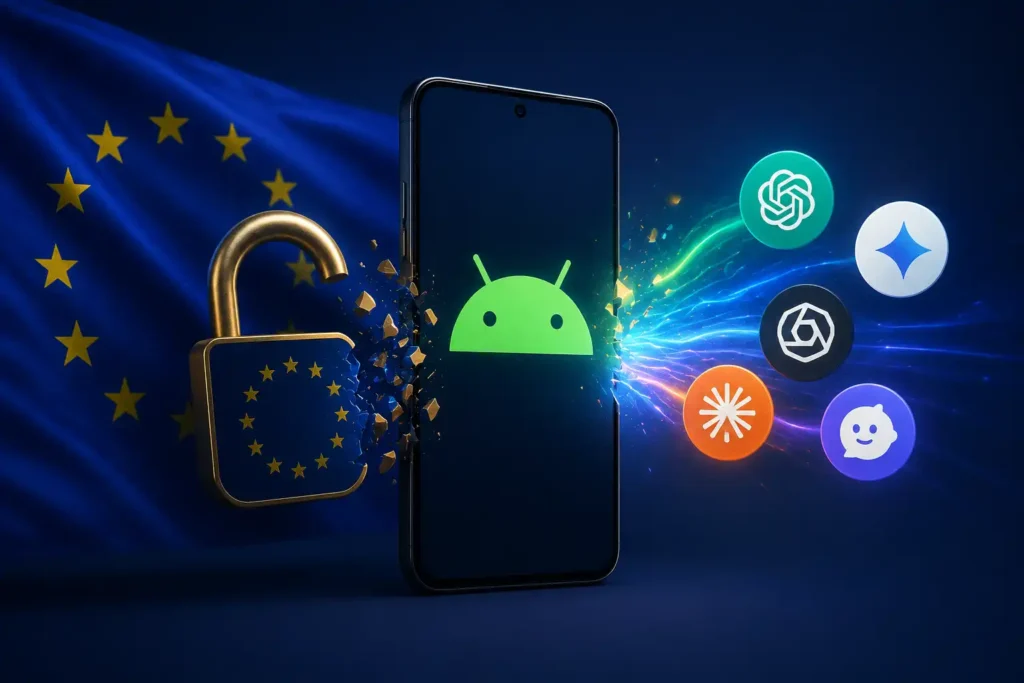
Imagine picking up your Android phone and saying “Hey ChatGPT” instead of “Hey Google,” and having it just work, controlling your apps, booking your rides, replying to your messages. In Europe, that future just became law.
On July 16, 2026, the European Commission issued two binding orders against Google under the Digital Markets Act. Together, they represent the most aggressive move any regulator has made against Big Tech’s AI dominance. Here’s what the ruling says, why Google is furious, and what it means for you, explained in plain English.
What Did the EU Actually Order?
The ruling breaks down into two separate mandates.
Order one: open up Android. Google must give rival AI assistants the same access to Android that its own Gemini assistant enjoys. That covers 11 groups of system features, including the big one: users will be able to set a rival assistant as their default and wake it by voice, just like they do with Gemini today. Those assistants must also be able to act inside apps, doing things like booking a taxi or suggesting replies in a chat. Google has until July 2027 to make the changes.
Order two: share the search data. Starting in January 2027, Google must share anonymized search data, including queries, clicks, and ranking information, with rival search engines and AI chatbot providers on fair and equal terms. The logic: Google is the only company big enough to collect this data at scale, and the EU wants to rebalance the playing field.
Importantly, these are not fines. They’re binding instructions that spell out exactly what Google has to do, which in some ways cuts deeper than a penalty ever could.
Why Is the EU Doing This?
The Commission’s concern is about the future, not the past. Regulators watched how platform monopolies formed in earlier tech eras, where controlling the operating system meant controlling which services won, and they’re trying to stop the same pattern before the AI market hardens.
Here’s the interesting twist: Gemini isn’t even winning the AI race. ChatGPT reportedly held around 70% of EU chatbot usage as of early 2026. But Gemini has something no rival has: deep, system level integration into Android, which runs on about 60% of EU mobile devices. The EU’s bet is that if that home field advantage compounds unchecked, the race ends before it really starts.
The timing adds weight. The ruling landed just two weeks after Europe’s top court upheld a 4.1 billion euro antitrust fine against Google over earlier Android practices.
How Google Responded
Google pushed back hard, and on one main theme: security.
The company’s president of global affairs, Kent Walker, warned that the decisions risk weakening privacy and security protections for millions of Europeans, arguing that Google had repeatedly offered alternative solutions. Android chief Sameer Samat added that users can already switch their default assistant in settings, and said the Commission was on the wrong track.
Security experts are genuinely split on this. Some agree that giving multiple AI assistants deep system access, including the ability to see screen content and act across apps, creates real new risks that businesses will need to manage. Others point out that Big Tech companies tend to discover their deep commitment to privacy right around the time a regulation threatens their business model.
The Apple Comparison Everyone Is Making
Google isn’t the first company to face these rules. Apple hit the same wall earlier this year, and chose a very different exit: it announced that its new Siri AI assistant simply won’t launch in the EU, after failed negotiations with regulators over the same interoperability requirements.
That gives Google two possible paths. Comply and redesign Android for Europe, or follow Apple and hold features back from the region. Around 427 million phones fall under EU regulation, so walking away from those users would be expensive. Most observers expect Google to comply, while fighting the details along the way. A key milestone comes in February 2027, when Google must publish the certification terms that decide which rival assistants qualify for access.
What This Means for You
If you’re in Europe, expect real choice by mid 2027. You’ll be able to pick ChatGPT, Claude, Perplexity, or another assistant as your phone’s default, wake it by voice, and let it work across your apps, things only Gemini can fully do on Android today.
If you’re outside Europe, watch closely anyway. EU tech rules have a habit of spreading. Companies often find it cheaper to apply one standard globally than to maintain separate versions, and other regulators frequently copy Brussels’ homework.
If you build AI products, this is the bigger story: the EU just established that AI assistant access is infrastructure, subject to the same openness rules as app stores and browsers. That precedent will shape how every platform, not just Android, handles AI in the years ahead.
Frequently Asked Questions
What is the EU Google Android AI ruling?
On July 16, 2026, the European Commission issued binding orders under the Digital Markets Act requiring Google to open 11 groups of Android features to rival AI assistants by July 2027, and to share anonymized search data with competitors starting January 2027.
Will I be able to replace Gemini with ChatGPT on Android?
In the EU, yes. By July 2027, users will be able to set a rival AI assistant as their default, activate it by voice, and let it perform actions inside apps, with the same system access Gemini has.
Was Google fined?
Not in this decision. These are binding specification measures that tell Google exactly what it must change, rather than a financial penalty. Separately, Europe’s top court recently upheld an older 4.1 billion euro Android antitrust fine.
Why is Apple’s Siri AI not available in the EU?
Apple decided not to launch its new Siri AI assistant in the EU after it could not reach agreement with regulators on how to comply with the same Digital Markets Act interoperability rules now being applied to Google.
Does this ruling apply outside Europe?
No, it only covers the EU. However, tech companies often extend EU driven changes globally to simplify their products, and regulators in other regions frequently adopt similar rules.
Regulation is becoming one of the biggest forces shaping AI in 2026. For more plain English breakdowns of the rulings, releases, and rivalries that matter, follow our latest AI news here on SubmitAll AI.