
Fable 5 vs Opus 4.8
July 2, 2026 · Peter101CJ
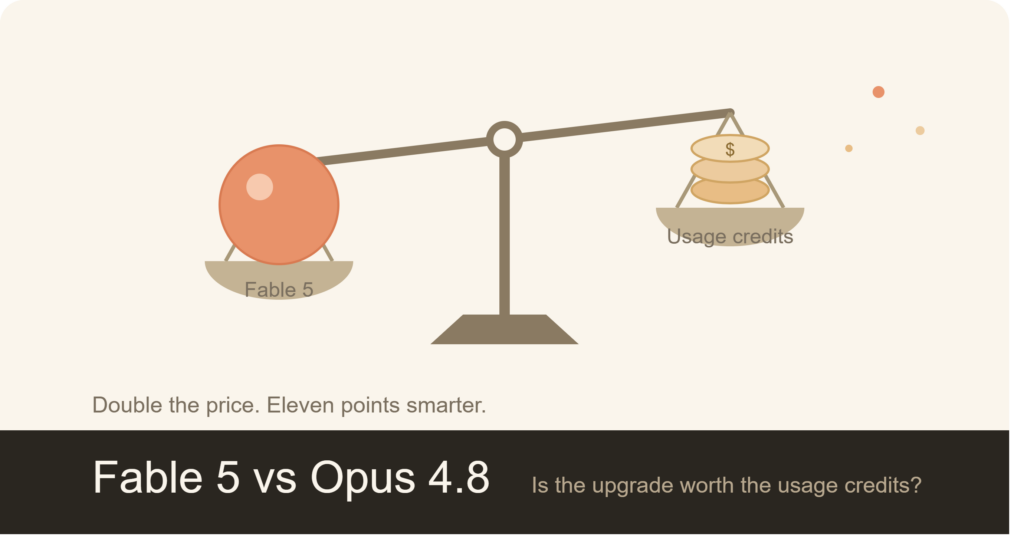
Is the Upgrade Worth the Usage Credits?
Most people look at Fable 5 and Opus 4.8 and assume the choice is obvious: newer model, better model, done. The real answer depends on two things nobody puts in the launch announcements, what you actually work on, and how you feel about paying double.
The short version
Fable 5 is Anthropic’s most capable generally available model, sitting in a new Mythos-class tier above Opus. Opus 4.8 is the flagship it replaced at the top of the lineup just twelve days after Opus 4.8 launched. Fable 5 is meaningfully smarter on hard, long-running work. It is also twice the price, runs through safety classifiers that can bounce your request, and after July 7, lives behind usage credits instead of your normal subscription allowance.
What you get for the extra money
The capability gap is real. On SWE-Bench Pro, a benchmark of difficult real-world software engineering tasks, Fable 5 scores 80.3% against Opus 4.8’s 69.2%. An eleven-point jump at the top of the capability curve is not cosmetic, it shows up as fewer failed runs and fewer moments where you have to step in and fix the model’s work.
The most quoted real-world example: Stripe reported that Fable 5 compressed a codebase-wide migration across 50 million lines of Ruby infrastructure into a single day. Their estimate for doing it by hand was a team working for more than two months.
Both models share the same core specs otherwise, a 1M token context window and up to 128k output tokens per request. This is not a bigger-brain-smaller-memory tradeoff. Same memory, bigger brain.
What it costs
Here is the pricing side by side on the API:
- Opus 4.8: $5 per million input tokens, $25 per million output
- Fable 5: $10 per million input tokens, $50 per million output
Exactly double. And there is a wrinkle: Opus 4.8 also has a Fast Mode at $10/$50 that runs about 2.5x standard speed. So at the identical price point, your choice is actually “Fable 5 intelligence” versus “Opus 4.8 speed.” That is a genuinely interesting fork depending on whether your bottleneck is quality or latency.
On subscriptions, the clock matters. Through July 7, Fable 5 is included in Pro, Max, Team, and select Enterprise plans for up to 50% of your weekly usage limits. After July 7, it moves to usage credits, a separate, metered bucket on top of your subscription. Opus 4.8 stays inside your normal plan limits.
The catch nobody should skip
Fable 5 ships with safety classifiers that Opus 4.8 does not have. If a request trips one, Fable 5 declines it and the request gets routed to Opus 4.8 instead, with a notification. Anthropic redeployed the model in July with those classifiers tightened, and in the near term some routine work, including ordinary coding and debugging, can trigger the fallback.
Think about what that means for the value question: you can pay Fable 5 prices and, on some fraction of requests, receive Opus 4.8 answers. That fraction should shrink as Anthropic tunes the classifiers, but right now it is part of the deal.
Two more practical differences. Fable 5 carries mandatory 30-day data retention with no zero-data-retention option, a dealbreaker for some compliance teams, where Opus 4.8 remains the safe choice. And Fable 5 consumes tracked usage much faster, so even inside the promo window it eats your weekly limit at a premium rate.
So who should upgrade?
Worth it: long-horizon agentic coding, multi-repo refactors, huge migrations, deep research synthesis, and any workflow where a failed run costs you real time. The eleven-point benchmark gap compounds over long task chains, one model finishing a job that another abandons halfway is worth far more than 2x per token.
Not worth it: everyday drafting, summarisation, standard coding help, Q&A, and anything Opus 4.8 already does without breaking a sweat. Paying double for identical outcomes just changes the invoice, not the result. And if your work is latency-sensitive, Opus 4.8 Fast Mode at the same price may serve you better than Fable 5.
The Simple Takeaway
Fable 5 is the better model, full stop, but “better” only pays for itself on hard, long, agentic work. If your tasks are routine, Opus 4.8 delivers nearly the same results at half the cost with no classifier lottery and no usage credits. The smart play before July 7: use the included 50% allowance to run your real workload through Fable 5 and see whether the difference shows up in your results, not just the benchmarks.
Frequently Asked Questions
Is Fable 5 just a better Opus 4.8? No, it is a different tier entirely. Fable 5 is a Mythos-class model, sharing its underlying model with the restricted Claude Mythos 5. Opus 4.8 remains the top of the Opus family.
How much more does Fable 5 cost? Double: $10/$50 per million tokens versus $5/$25 for Opus 4.8. On subscriptions, Fable 5 moves to usage credits after July 7, while Opus 4.8 stays within your plan.
What happens when Fable 5 refuses my request? You get a notification and the request is handled by Opus 4.8 instead. On the API, the response returns a refusal stop reason so developers can handle fallback programmatically.
Do they have the same context window? Yes, both offer a 1M token context window and up to 128k output tokens.
Should I test it before July 7? Yes. Until then, Fable 5 is included in paid plans for up to 50% of weekly usage limits, effectively a free trial for the exact question this post asks.