What Is RAG
July 2, 2026 · Peter101CJ
Retrieval-Augmented Generation Explained in Plain English
Most people hear “RAG” and think it’s another piece of AI jargon they can safely ignore. Here’s the thing: nearly every AI product you use that actually knows your stuff, your documents, your company wiki, your support tickets, is running RAG under the hood.
The problem RAG solves
An AI model like ChatGPT or Claude learned everything it knows during training, which ended at some fixed point in the past. It has never seen your company’s HR policy, yesterday’s sales report, or the contract sitting in your inbox.
Ask it about any of those and one of two things happens: it admits it doesn’t know, or worse, it confidently makes something up. That second failure has a name: hallucination.
You could try retraining the model on your documents, but that costs a fortune, takes weeks, and would need redoing every time a document changes. There had to be a cheaper trick. RAG is that trick.
What RAG actually means
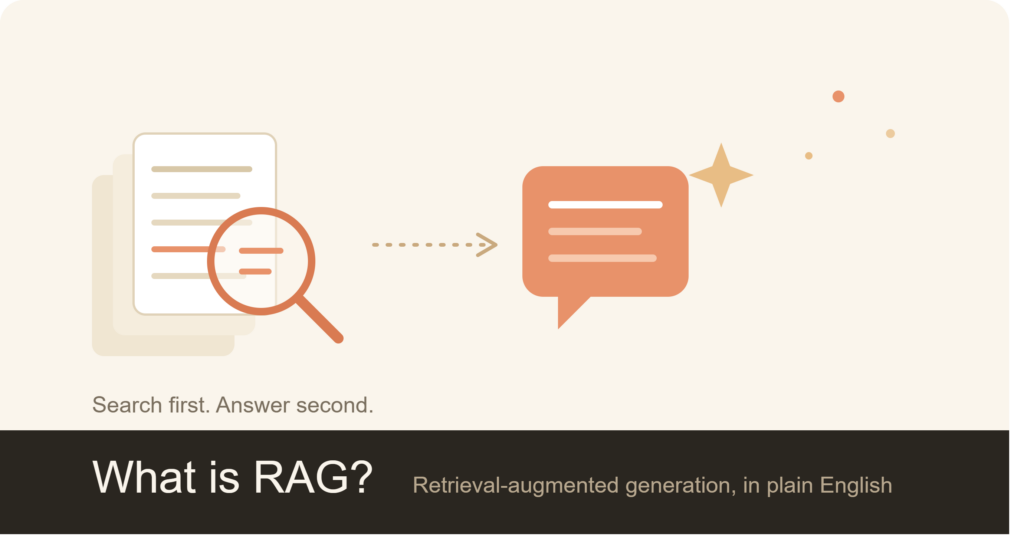
RAG stands for Retrieval-Augmented Generation. Ignore the mouthful, the three words describe three steps:
- Retrieval: when you ask a question, the system first searches a knowledge source (your files, a database, the web) and pulls out the most relevant snippets.
- Augmented: those snippets get quietly attached to your question before it reaches the AI model.
- Generation: the model writes its answer using what it just read, not just what it memorised in training.
The human analogy: RAG is an open-book exam. Without RAG, the model answers from memory alone. With RAG, it gets to look at the relevant page first, and it can cite where the answer came from.
How it works under the hood (still plain English)
There’s one clever bit worth knowing: how the system finds the “relevant snippets” in a pile of thousands of documents.
Your documents get chopped into small chunks, and each chunk is converted into a list of numbers called an embedding. Think of an embedding as a location on a giant map of meaning, chunks about similar topics end up near each other, even if they use completely different words. “How do I get my money back?” lands right next to your refund policy, because the meaning is close, even though the word “refund” never appeared in the question.
When you ask something, your question gets placed on the same map, the system grabs the closest chunks, hands them to the model, and the model writes the answer. All of this happens in a second or two. The place where those chunks and their map coordinates live is called a vector database, a term you’ll see constantly in RAG discussions, and now you know it’s just the filing cabinet for the meaning-map.
Why everyone uses it
RAG became the default architecture for serious AI products for four reasons:
- Fresh answers: update a document and the AI’s knowledge updates instantly, no retraining.
- Fewer hallucinations: the model is grounded in real text sitting right in front of it, instead of improvising from memory.
- Receipts: because the system knows which chunks it retrieved, it can cite sources, critical for legal, medical, and enterprise use.
- Privacy and cost: your data stays in your own database instead of being baked into a model, and it costs pennies compared to training.
When Claude searches the web before answering, when a customer-support bot quotes the actual returns policy, when an enterprise assistant answers from the company wiki, that’s RAG every time.
Where RAG falls short
It isn’t magic. If the retrieval step grabs the wrong chunks, the model reasons beautifully from the wrong material, garbage in, eloquent garbage out. Messy, contradictory, or outdated documents produce messy answers. And questions that require reading everything (“summarise all 400 contracts”) strain a system built to fetch a handful of relevant snippets.
The field’s response has been to keep improving the retrieval half: better search, smarter chunking, and agentic RAG, where the model runs multiple searches, checks its own results, and digs deeper, closer to a researcher than a librarian.
The Simple Takeaway
RAG is the open-book exam for AI: search first, answer second. It’s why modern AI tools can know your data without being trained on it, why they can cite sources, and why they hallucinate less than raw models. If you’re building anything on AI, or just evaluating tools that claim to “know your documents”, RAG is the machinery making that claim possible.
Frequently Asked Questions
What does RAG stand for? Retrieval-Augmented Generation, the AI retrieves relevant information first, then generates its answer using it.
Is RAG the same as fine-tuning? No. Fine-tuning changes the model itself through additional training, good for teaching style or specialised skills. RAG leaves the model untouched and hands it fresh information at question time, good for knowledge that changes. Many products use both.
Does RAG stop hallucinations completely? It reduces them significantly by grounding answers in real text, but it can’t eliminate them. If retrieval fetches the wrong material, the answer will still be wrong, just confidently wrong with citations.
What is a vector database? The storage system for RAG: it holds document chunks along with their embeddings (meaning-map coordinates) so the system can find relevant text by meaning rather than exact keywords.
Do I need to be a developer to use RAG? No. If you’ve uploaded a file to an AI chatbot or used one that searches the web or your company’s docs, you’ve already used RAG, it was just working invisibly.