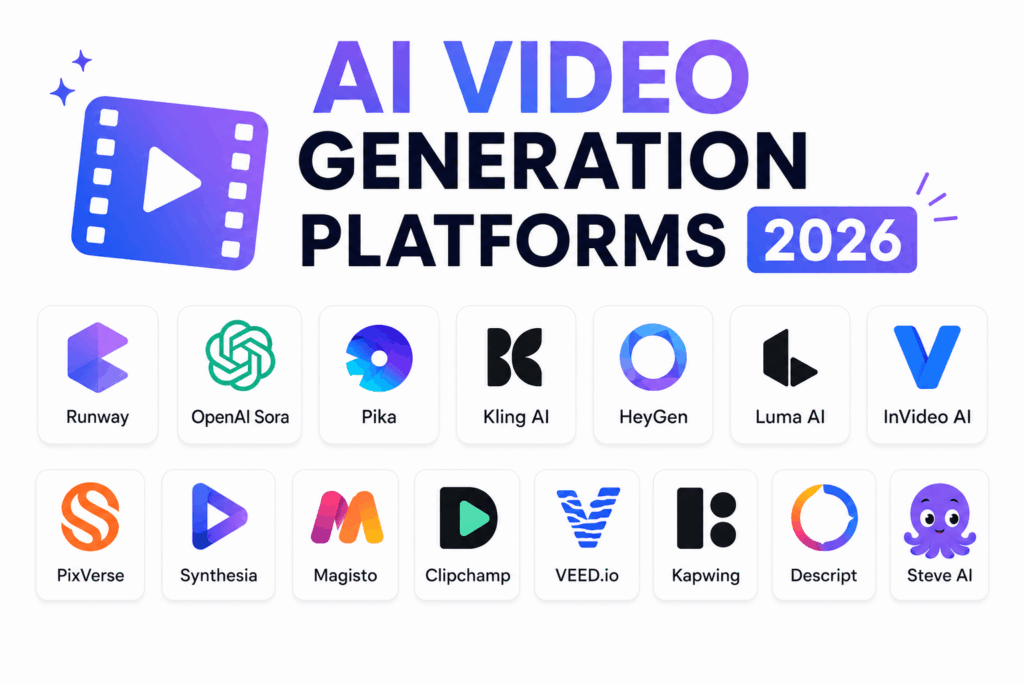
AI Video Generation Platforms 2026
July 2, 2026 · Peter101CJ
Best AI Video Generation Platforms for Businesses in 2026
Most companies shopping for AI video make the same mistake: they pick a single model instead of a platform. In 2026 that is backwards. The best model changes every quarter (ask anyone who built on Sora), models win different shot types, and prices vary five-fold for similar output. What a business actually needs is an AI video generation platform: one place, one bill, many models. Here are the best options.
Why businesses need a platform, not a model
Three facts drive this. First, no model wins everything: Seedance leads lip-sync, Veo leads cinematic audio, Kling leads price and 4K, so production teams route by shot type. Second, vendor risk is real: OpenAI shut down the Sora app in April 2026 and retires its API in September, stranding anyone who hard-coded it. Third, unit costs diverge wildly, from about $0.02 per second on Seedance’s fast tier to premium rates many times that. A platform lets you switch models by changing one parameter instead of rebuilding your pipeline.
1. fal.ai: the best multi-model AI video platform for developers
fal.ai hosts 600+ models behind a single API key, including Kling 3.0, Veo 3.1, Seedance, and open-source Wan 2.6, at competitive per-second rates (roughly $0.05 to $0.40 per second depending on model). For engineering teams, it is the fastest way to A/B models in production and reroute when a better or cheaper one ships. Similar hubs worth evaluating: Replicate, AIMLAPI, and Atlas Cloud, all offering the major models under one key.
2. Runway: the best AI video platform for creative teams
Runway is a platform in a different sense: a full production environment with generation, editing timeline, motion brush, inpainting, and character consistency tools, and since late 2025 it also bundles third-party models. One subscription (Standard from about $12 to $15 per month, Pro and Unlimited above it) includes Runway Gen-4.5 plus Veo 3.1, Kling 3.0 Pro, and Seedance access from one dashboard. For marketing and post-production teams that want humans in the loop rather than an API, this is the strongest option.
3. Google Vertex AI: the best enterprise AI video platform
If your company already runs on Google Cloud, Veo 3.1 through Vertex AI is the lowest-friction enterprise path: IAM permissions, billing, quotas, and compliance all inherit from your existing cloud setup, and outputs carry SynthID invisible watermarking for provenance. The tradeoff is a single-vendor model lineup and premium pricing (Veo API rates run to about $0.75 per second at the top tier). Best for regulated industries and Google-native enterprises.
4. Dreamina and CapCut: the best platform for social content at scale
ByteDance’s Dreamina wraps the Seedance model family (2.0, the budget mini variant, and the 4K variant) in an end-to-end creator workflow: storyboarding with its image model, generation, upscaling, and soundtrack tools in one place, with CapCut handling editing and publishing. For social media teams producing daily short-form video, this vertical integration beats stitching together separate tools, and Seedance’s fast tier is the cheapest frontier-quality generation available at roughly $0.02 per second.
5. Open-source self-hosting: the platform you own
For businesses with GPU capacity and privacy requirements, self-hosting Wan 2.6 is a legitimate platform strategy: unlimited generation, no per-clip fees, no data leaving your infrastructure, and no vendor shutdown risk. The costs are hardware and engineering time. Many teams run a hybrid: Wan for volume drafts, a hosted frontier model for hero shots.
How to choose: a simple routing strategy
Pick the platform that matches your team, then route inside it. A pattern that works for most businesses: draft and iterate on the cheapest adequate model (Seedance fast or Wan), upgrade hero content to Veo 3.1 or Kling 3.0, and keep every prompt and asset portable so no single vendor can strand you. Abstract the model name behind one configuration variable in your code or workflow docs. The Sora shutdown taught everyone this lesson once; it should not need teaching twice.
The Simple Takeaway
An AI video generation platform beats any single model because the leaderboard will not sit still. Developers should start with a multi-model hub like fal.ai, creative teams with Runway, Google-native enterprises with Vertex AI, and social teams with Dreamina. Whatever you choose, build so that switching models costs you a config change, not a migration. For the underlying model rankings, see our guide to the best AI video generators in 2026.
Frequently Asked Questions
What is an AI video generation platform? A service that provides access to one or more AI video models plus the surrounding workflow (APIs, editing, billing, governance), as opposed to a single standalone model.
What is the best AI video generation platform for developers? Multi-model API hubs like fal.ai, which offer Kling, Veo, Seedance, Wan and hundreds more behind one API key at per-second pricing.
What does AI video generation cost for a business? From roughly $0.02 per second (Seedance fast tier) to about $0.75 per second (premium Veo via API). A hundred 10-second clips can cost anywhere from about $20 to $500 depending on the model.
Which platform is safest for regulated enterprises? Google Vertex AI, thanks to inherited cloud compliance, access controls, and SynthID watermarking, with Runway as the strongest option where creative teams need tooling on top.
Should businesses self-host an AI video model? Only with GPU capacity and engineering support. Open-source Wan 2.6 makes self-hosting viable for volume generation and strict data-privacy needs, often alongside a hosted model for hero content.