Google AI Video Generator Veo 2026
July 2, 2026 · Peter101CJ
Google’s AI Video Generator Explained: What Veo Is and How to Use It Free
Most people searching for “the Google AI video generator” do not know its name. It is called Veo, it is built by Google DeepMind, and in 2026 it is arguably the best all-round AI video model on the market. Better still: since April 2026, every Google account gets to use it free. Here is what Veo is, where it lives, and exactly how to get your free generations.
What is Google Veo?
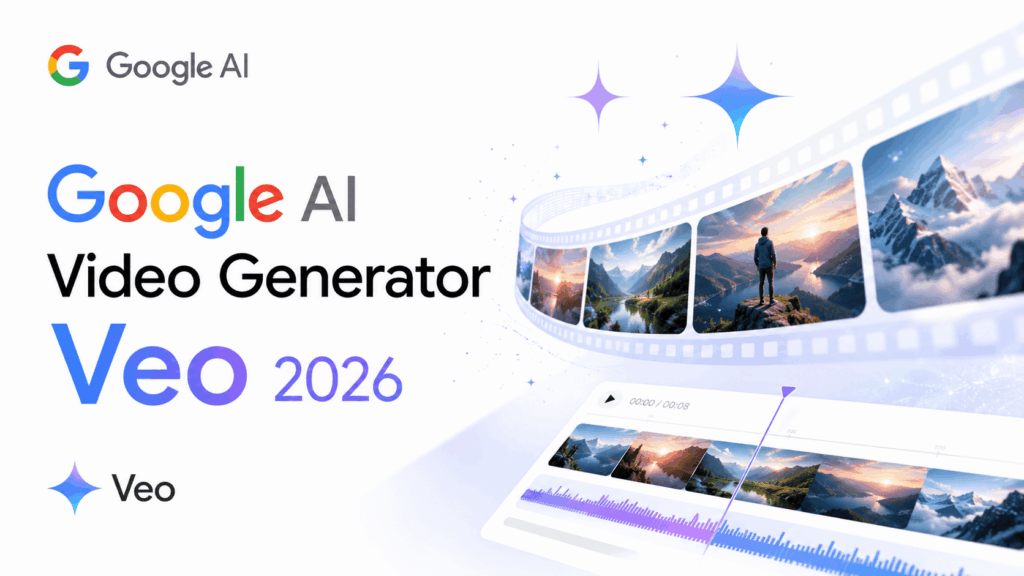
Veo is Google DeepMind’s video generation model. Type a prompt (or upload reference images) and it generates cinematic video with synchronized sound: dialogue with accurate lip-sync, ambient noise, sound effects, and music, all in a single pass. DeepMind CEO Demis Hassabis described it as AI video leaving its silent film era.
The current version, Veo 3.1, arrived in January 2026 with three headline upgrades: native 4K output, native vertical 9:16 video (built for Shorts and Reels rather than cropped from widescreen), and Ingredients to Video, which accepts up to three reference images to keep a character, object, or style consistent across scenes. It also added pro controls: camera moves, first-to-last-frame transitions, outpainting to extend the frame, object insertion and removal, and scene extension for sequences beyond 60 seconds. Every output carries Google’s invisible SynthID watermark for AI-content identification.
Where the Google AI video generator lives
Veo is not one app. It is embedded across Google’s ecosystem:
- Gemini app: generate clips in chat on Plus, Pro, and Ultra plans.
- Google Flow (labs.google/flow): DeepMind’s dedicated AI filmmaking tool, built for prompt-driven cinematic work and longer projects with scene continuity.
- Google Vids: the workplace video tool, now with Veo generation, AI avatars, and Lyria 3 AI music, publishing straight to YouTube.
- YouTube Shorts and YouTube Create: Veo generation directly inside the Shorts workflow.
- Gemini API and Vertex AI: developer access, priced around $0.75 per second of generated video at the top tier.
How to use Veo 3.1 free in 2026
This is the part most people miss. On April 2, 2026, Google made Veo 3.1 free for all Google account holders through two products, and you can combine them:
- Google Vids: every personal Google account gets 10 free Veo 3.1 generations per month. Sign in, open Vids, and generate. No subscription required.
- Google Flow: free accounts get 50 AI credits per day (180 per day in some countries), resetting every 24 hours. Go to labs.google/flow, sign in with a personal account (18+, available in 140+ countries), check the credit cost of your chosen model in settings, and generate. Unused credits expire at midnight.
The free-tier limits to know: clips max out around 8 seconds, resolution is capped at 720p, outputs carry a visible watermark (paid tiers remove it), and audio generation is reserved for paid plans. For more genuinely free options beyond Google, see our roundup of the best free AI video generators.
How good is Veo 3.1 really?
In our ranking of the best AI video generators of 2026, Veo 3.1 is the best all-rounder. It leads Western models on prompt understanding, cinematic color and lighting, and native synchronized audio, and Google’s human-rater tests found evaluators preferred Veo output over other leading models on overall quality. Its rivals win specific niches: ByteDance’s Seedance 2.0 tops the with-audio leaderboard and owns lip-sync, and Kling 3.0 undercuts Veo heavily on price. But as a single dependable choice with enterprise-grade distribution, Veo is the safest pick, which is exactly why filmmakers, including Darren Aronofsky’s studio Primordial Soup, have partnered with DeepMind to produce short films with it.
Tips for better Veo results
Veo responds dramatically better to cinematic, director-style prompts. Specify shot type, lighting, subject details, and mood: “Cinematic close-up, warm window light, a woman in her 30s in a green turtleneck holding a ceramic mug, shallow depth of field, golden hour tones” will beat “woman drinking coffee” every time. For maximum control, start from a reference image rather than text alone, and use Flow (not Vids) when you need scene continuity across multiple clips.
The Simple Takeaway
Google’s AI video generator is Veo 3.1: the strongest all-round video model of 2026, with native audio, 4K, vertical output, and character consistency, woven through Gemini, Flow, Vids, and YouTube. And thanks to Google’s April giveaway, you can test it today for exactly nothing: 10 free generations a month in Vids plus 50 daily credits in Flow. Start free, learn to prompt like a director, and only pay when your ambitions outgrow the allowance.
Frequently Asked Questions
What is Google’s AI video generator called? Veo, built by Google DeepMind. The current version is Veo 3.1, released in January 2026.
Is Google Veo free? Yes, within limits. Every Google account gets 10 free Veo 3.1 generations per month in Google Vids, plus 50 free daily credits in Google Flow. Free clips are watermarked, capped around 8 seconds, and limited to 720p.
Can Veo generate sound? Yes. Veo 3.1 generates synchronized dialogue with lip-sync, ambient sound, effects, and music natively, although audio is a paid-tier feature in the free products.
How do I access Veo as a developer? Through the Gemini API or Vertex AI on Google Cloud, priced at roughly $0.75 per second of generated video at the top tier, with SynthID watermarking on all outputs.
Is Veo better than Sora? In 2026 the question is moot: OpenAI shut down the Sora app in April 2026 and retires its API in September. Among available models, Veo 3.1 is the leading Western option.