What Is Claude Fable 5? Fable AI Capabilities and the U.S. Government Ban Explained
June 17, 2026 · Peter101CJ
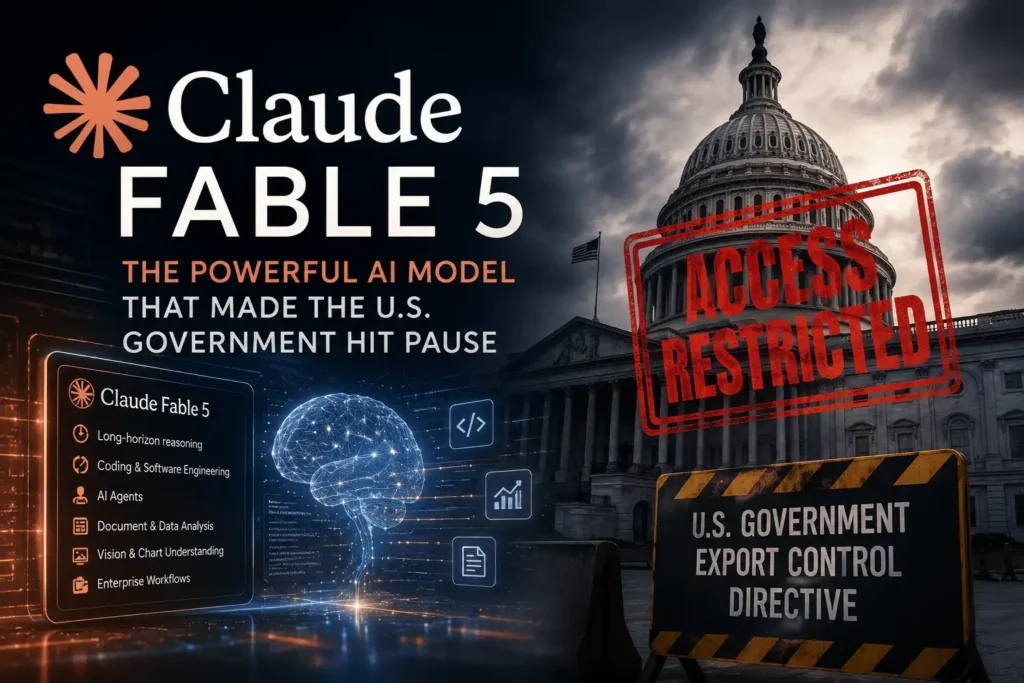
The AI Story That Suddenly Stopped Being Just a Tech Story
Every so often, a new piece of technology arrives and people in tech get excited.
That part is normal.
A faster phone. A smarter chatbot. A new app that promises to save you time. We have seen this movie before.
But every now and then, something lands that makes the conversation jump from developer forums and startup circles into government offices. That is what happened with Claude Fable 5, Anthropic’s new AI model.
At first, Fable sounded like another big step forward in artificial intelligence. It could code. It could reason through complicated work. It could keep going on long projects instead of giving up halfway through. It could look at documents, charts, tables, and visual designs and understand what was going on.
Then, almost as quickly as it appeared, access was pulled back.
Not because people lost interest.
Because the U.S. government stepped in.
And that is where the story becomes bigger than one AI model.
This is not just about Anthropic. It is not just about Fable. It is about a question we are all going to hear more often:
When an AI system becomes powerful enough to help people solve hard problems, when does it also become powerful enough to worry governments?
Let’s unpack it in plain English.
What Is Claude Fable 5?
Claude Fable 5 is an advanced AI model from Anthropic, the company behind Claude.
You can think of it as a more capable version of the AI assistants many people already use today. But instead of just answering a quick question or helping rewrite an email, Fable was designed for bigger, messier, longer tasks.
That matters.
Most people still think of AI as a chat window. You ask a question. It gives an answer. End of story.
Fable points toward something different.
It is closer to an AI worker that can take a goal, break it into steps, keep track of what it is doing, test its own work, and keep pushing through a project over a longer period of time.
In simple terms, Fable was built less like a calculator and more like a junior teammate.
Not a human teammate. Not someone with judgment, ethics, or life experience.
But a system that can take on more of the “figure it out” part of work than previous models could.
Why People Were Paying Attention to Fable
Fable became interesting because it was not just better at one thing.
It appeared to be better at a cluster of things that, when combined, make AI feel much more useful.
That includes:
- Long-running tasks
- Software engineering
- AI agents
- Research and analysis
- Document-heavy work
- Vision and chart understanding
- Multi-step business workflows
- Self-checking and testing
Let’s make that less abstract.
Imagine you are not asking AI, “Can you write me a paragraph?”
Instead, you are asking:
“Help me migrate this large codebase.”
“Review this contract and find the risky parts.”
“Look at these financial tables and tell me what changed.”
“Build a working prototype from this design.”
“Research this technical problem and come back with a structured answer.”
“Plan the steps, do the work, check the output, and tell me where you are uncertain.”
That is the kind of world Fable was pointing toward.
And that is why the news matters.
The Big Capability: Fable Can Work for Longer
One of the most important ideas around Fable is something called long-horizon work.
That phrase sounds technical, but the idea is simple.
A short-horizon task is something like:
“Summarize this email.”
A long-horizon task is something like:
“Analyze this entire project, find what is broken, create a plan, make the changes, test them, and explain the trade-offs.”
The second task is much harder because it requires memory, planning, patience, and course correction.
Humans do this all day. We start a task, hit a problem, adjust the plan, try again, and keep going.
Traditional chatbots often struggle with that. They can be impressive in one exchange, then lose the thread as the job gets longer.
Fable was designed to stay useful deeper into the work.
That is a big shift.
Because the more an AI can keep going, the less it feels like a tool you use for five minutes and the more it feels like a system you can hand work to.
Fable and AI Agents: Why That Matters
To understand Fable, you also need to understand AI agents.
An AI agent is not just a chatbot that talks. It is an AI system connected to tools.
Those tools might let it:
- Search files
- Read documents
- Write code
- Run tests
- Use a browser
- Create reports
- Call other smaller AI agents
- Check whether a task succeeded
So when people talk about Fable working inside an “agent harness,” they mean Fable can sit at the center of a workflow and coordinate actions.
Think of the model as the brain and the agent system as the hands.
The brain decides what to do next.
The hands let it interact with real tools.
That is powerful.
It is also exactly why governments start paying attention. An AI that writes a poem is one thing. An AI that can reason, use tools, inspect software, and keep trying different paths is something else.
Fable’s Coding Capabilities
One of the clearest use cases for Fable is software engineering.
That does not just mean writing small snippets of code.
The bigger promise is helping with the kind of work that usually eats up weeks or months inside engineering teams.
For example:
- Moving old software to a new framework
- Finding bugs across a large codebase
- Writing tests
- Reviewing pull requests
- Turning designs into working interfaces
- Checking whether the finished product matches the original goal
- Handling complex implementation work across many files
For developers, this is exciting because a lot of software work is not glamorous. It is careful, detailed, repetitive, and easy to get wrong.
If an AI can handle more of that without constant hand-holding, it could speed up entire teams.
But there is another side to that same capability.
The same skills that help an AI find bugs can also help it find vulnerabilities.
And the same skills that help it test software can also help it probe systems in ways that make security officials uncomfortable.
That is the dual-use problem.
A hammer can build a house or break a window.
Advanced AI has the same issue, except the hammer can reason.
Fable’s Vision and Document Skills
Fable was also positioned as strong at vision-heavy work.
That means it can understand more than plain text.
It can look at things like:
- Charts
- Tables
- Diagrams
- Screenshots
- PDFs
- Design files
- Document layouts
This is important because real business information usually does not live in neat paragraphs.
It lives in spreadsheets, slide decks, contracts, dashboards, screenshots, scanned files, and messy PDFs.
A model that can understand those materials can help with work in finance, law, analytics, architecture, operations, and research.
For a normal business user, this is one of the most practical parts of Fable.
You do not need to be a programmer to understand the value of saying:
“Here are three reports. Tell me what changed, what matters, and what I should look at first.”
That is the kind of AI people actually want.
Not magic.
Just less friction.
Fable’s Enterprise Workflow Promise
The enterprise angle is simple: companies do not just need AI to answer questions.
They need AI to help complete work.
That means taking a messy business request and turning it into a useful output.
A manager might want a market analysis.
A lawyer might want a contract review.
A finance team might want a variance explanation.
A product team might want research turned into a roadmap.
An operations team might want a process redesigned.
Fable was built for that world: multi-stage knowledge work where the AI can take a larger assignment and move through it with less supervision.
That phrase “less supervision” is doing a lot of work.
It is the dream and the concern at the same time.
Less supervision means more productivity.
Less supervision also means more risk if the system misunderstands the goal, oversteps boundaries, or finds a shortcut nobody intended.
So Why Did the U.S. Government Step In?
The U.S. government issued an export-control directive that restricted access to Fable 5 and Mythos 5 by foreign nationals.
In plain English, the concern was national security.
The government appeared worried that these models could be used in sensitive areas, especially cybersecurity. Anthropic said it understood the decision was connected to concern about a possible method for bypassing Fable’s safeguards.
That is an important detail.
Fable had safeguards. Anthropic said the model included protections in areas like cybersecurity and biology, including routing certain risky requests away from Fable.
But the government’s concern was not simply, “Does the model have rules?”
The concern was closer to:
“What happens if someone finds a way around those rules?”
That is the nightmare scenario for any powerful AI system.
Because with a less capable chatbot, a jailbreak might produce something inappropriate or against policy.
With a much more capable AI agent, a jailbreak could potentially unlock more serious abilities.
That is why this became a government issue.
Why Anthropic Disabled Access for Everyone
The government directive focused on foreign-national access.
But Anthropic said the practical effect was that it had to disable Fable 5 and Mythos 5 for all customers to comply.
That may sound strange at first.
Why not just block people outside the United States?
Because “foreign national” does not simply mean “someone overseas.”
It can include non-U.S. citizens inside the United States. It can include employees, contractors, customers, and users in complicated legal and technical situations.
For a global AI product, separating access cleanly is not always simple.
So Anthropic pulled access more broadly while it worked through the situation.
For customers, that meant sudden disruption.
For the AI industry, it sent a message: frontier models may no longer be treated like normal software products.
They may be treated more like strategic technology.
The Bigger Question: Is Advanced AI Becoming an Export-Control Issue?
This is where the Fable story gets bigger.
The U.S. already controls the export of certain advanced technologies, including some chips and military-related tools.
Now the question is whether the most powerful AI models belong in a similar category.
That is not a small shift.
Software has historically been hard to control once released. It spreads. It gets copied. Competitors learn from it. Open-source communities build alternatives. Companies in other countries race to catch up.
So if one government restricts one model, it may slow access for a while.
But it probably does not stop the broader direction of AI progress.
That is why the Fable decision is controversial.
Supporters of restriction may say:
“This is too powerful to release without stronger controls.”
Critics may say:
“You are punishing one company while the rest of the industry keeps moving.”
Both sides are reacting to the same reality: AI capability is rising fast, and the old rulebook does not fit neatly anymore.
The Simple Way to Understand the Risk
Here is the easiest way to think about it.
Older AI was like a very smart autocomplete.
Modern AI is becoming more like a problem-solving engine.
And agentic AI is becoming more like a problem-solving engine with tools.
That last part changes everything.
When an AI can only produce text, the damage is limited by what someone does next.
When an AI can use tools, write code, run checks, inspect systems, and keep trying, the line between “advice” and “action” gets thinner.
That does not mean every advanced AI is dangerous.
It means the stakes are higher.
A helpful system can help more.
A misused system can do more harm.
That is the tension at the center of the Fable story.
Why Fable Matters Even If You Never Use It
You might be thinking, “I am not an AI researcher. I am not a developer. Why should I care?”
Because this story is a preview.
The tools that feel advanced today usually become normal tomorrow.
A few years ago, AI writing tools felt futuristic. Now they are everywhere.
Image generation used to feel like a lab demo. Now it is part of marketing, design, and social media.
Coding assistants were once niche. Now they are becoming part of everyday software development.
Fable is part of the next step: AI that does not just respond, but works through bigger goals.
That will affect businesses, schools, governments, cybersecurity teams, legal teams, researchers, and everyday workers.
The question is not whether AI becomes more capable.
It will.
The question is how society manages access, safety, competition, and trust while that happens.
The Productivity Side of Fable
It is easy to focus only on the risk, but that would miss half the story.
The reason people want models like Fable is because they can be genuinely useful.
For companies, a model like this could reduce the time needed for complex projects.
For small teams, it could make advanced technical work more accessible.
For researchers, it could help explore ideas faster.
For analysts, it could turn messy information into clearer decisions.
For developers, it could remove hours of repetitive work.
For ordinary users, it could make computers feel less like machines you operate and more like assistants that understand what you are trying to accomplish.
That is the promise.
Not replacing human judgment.
Not turning every person into a passive observer.
But giving people more leverage.
The danger is that leverage works in every direction.
The Safety Side of Fable
Anthropic has built its brand around AI safety more than many other AI companies.
That makes the Fable situation especially interesting.
This was not a reckless company saying, “Release everything and see what happens.”
Anthropic said Fable included safeguards, red-teaming, and routing for sensitive requests.
Yet the model still triggered government action.
That tells us something important.
In frontier AI, safety is no longer just a company policy question.
It is becoming a national-security question.
And once governments enter the conversation, the rules can change quickly.
What Businesses Should Learn From the Fable News
If you run a business, the lesson is not “avoid AI.”
That would be the wrong takeaway.
The real lesson is: treat powerful AI like infrastructure, not a toy.
Before a company builds around advanced AI tools, it should ask:
- What happens if access changes suddenly?
- What data are we sending into the system?
- Which tasks should always require human approval?
- Are we using AI for advice, action, or both?
- Do we understand the model’s limits?
- Do we have a fallback plan?
- Who is responsible when the AI gets something wrong?
The Fable access disruption is a reminder that AI vendors, governments, and customers are now connected in ways that did not exist before.
A product decision in Silicon Valley can become a compliance issue overnight.
What Everyday Users Should Take Away
For everyday users, the takeaway is simpler.
AI is getting more capable, but capability is not the same as wisdom.
A model can be brilliant at solving a task and still misunderstand what you truly wanted.
It can move fast and still move in the wrong direction.
It can produce polished work and still miss context.
That means the best way to use AI is not blind trust.
It is partnership.
Use AI to speed up thinking, drafting, coding, researching, and organizing.
But keep human judgment in the loop, especially when the work touches money, security, health, law, reputation, or people’s lives.
The Real Story Behind Fable
Fable is not just a story about one AI model getting restricted.
It is a story about the moment AI started to look less like software and more like power.
Power to build.
Power to automate.
Power to discover.
Power to accelerate work.
Power to cause harm if used badly.
That is why this moment feels different.
The conversation is moving from “What can AI do?” to “Who should be allowed to use the most powerful versions, under what rules, and with what oversight?”
That debate is not going away.
Fable just made it harder to ignore.
Frequently Asked Questions About Claude Fable 5
What is Claude Fable 5?
Claude Fable 5 is an advanced AI model from Anthropic designed for ambitious, long-running tasks such as coding, research, enterprise workflows, document analysis, and agent-based work.
What makes Fable different from a normal chatbot?
A normal chatbot usually answers one question at a time. Fable was designed to handle longer, more complex projects, plan across multiple stages, test its own work, and operate inside AI agent systems.
What can Fable do?
Fable can help with software engineering, large code migrations, research, business analysis, document-heavy workflows, visual understanding, charts, tables, PDFs, and multi-step tasks.
Why did the U.S. government restrict access to Fable?
The U.S. government cited national security concerns and issued an export-control directive restricting access to Fable 5 and Mythos 5 by foreign nationals. Anthropic said it understood the concern involved a possible method for bypassing Fable’s safeguards.
Is Claude Fable 5 banned?
Access was suspended after the U.S. government directive. The situation is best understood as an access restriction tied to export controls and national-security concerns, not a simple consumer-product ban.
Why does the Fable news matter?
Fable matters because it shows how advanced AI is moving beyond simple chat into long-running, agentic work. That creates huge opportunities for productivity, but it also raises serious questions about safety, cybersecurity, access, and government control.
Final Thought: We Are Entering the Age of AI That Acts
The Fable story is not really about whether one model is good or bad.
It is about what happens when AI becomes capable enough to take on real work.
That is the future we are walking into.
AI will help people write, code, research, design, analyze, and build faster than before. It will give small teams abilities that once belonged only to large organizations. It will change how businesses think about work.
But the more useful AI becomes, the more important the rules around it become too.
Fable is a signal.
The next chapter of AI will not just be about smarter models.
It will be about trust, access, safety, power, and control.
And whether we like it or not, that conversation has already started.